
DOWNLOAD the conversational framework: 10-Fs and One Honest Conversation
What do your colleagues want you to ask?
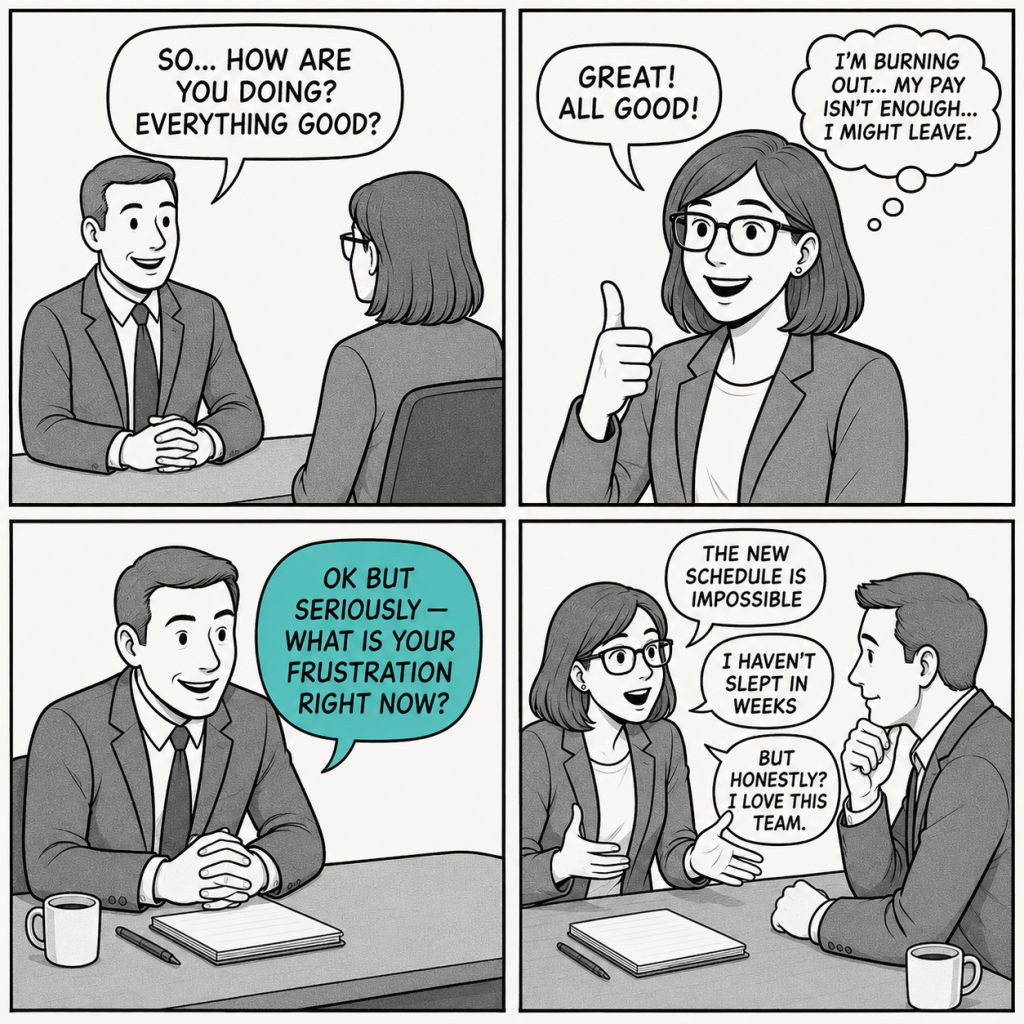
People suffer at work when they feel unseen. The 10-F Check-In is a once-a-year, one-on-one conversation designed to see the whole person, not just the employee. It is not a performance review. It is not a counselling session. It is a leader saying: I see you, I care about all of you, and I want to know how you’re actually doing.
What does the research tell us?
The research is unambiguous about what happens when people feel like those overseeing their work don’t see them: disengagement, quiet withdrawal, and eventually turnover. Gallup’s engagement data consistently shows that one of the strongest predictors of whether someone stays and thrives is whether they believe their leader cares about them as a person. Google’s Project Aristotle found psychological safety to be the single most important factor in team effectiveness. And decades of occupational health research confirm the spillover effect: stress in one domain of life such as family, finances, or health, directly undermines performance in another.
Leaders who only ask about work are flying blind.
The question isn’t whether your people have things going on outside of their role. The question is whether you’ve built a rhythm that gives them permission to tell you. The question is whether you’re building a culture where there is an invitation for vulnerability. Are you posturing yourself to be open to uncovering what Susan Scott in Fierce Conversations calls “the ground truth.”
The 10-F Check-In
I can’t take credit for this idea. My board vice chair told me about a rhythm his executive coach uses with him. It is a structured check-in organized around life categories that all start with F (he asked me 5 of them, but I expanded to 10). I loved it, adapted it for my own context, and now use it annually with my leadership team.
It’s ten questions but one conversation: Fit, Fun, Finances, Family, Faith, Forming, Flourishing, Fortitude, Fitness, and Frick.
How to Use It
Set the tone at the outset: “This isn’t a review. I just want to know how you’re doing and it gives me an opportunity to put my finger on the pulse of our culture.”
You don’t need to cover all ten in one sitting. Let the conversation go where it wants to want to go. Your only job is to listen, ask one follow-up question, and resist the urge to fix. If something surfaces that needs action, name it and schedule a separate conversation.
We find that the 10-F Check-In does something no performance review ever will. It gives people permission to be known and heard. And people who feel known stay longer, work harder, and serve better.

