
If you are an executive leader hired to run an organization that is accountable to a board or stakeholders, here is a straightforward truth: your time is not entirely your own. You were hired to steward it on behalf of a mission. And it is not an unreasonable question for any board director to ask: How did you allocate your time this month, and how effective was that investment in moving the mission forward?
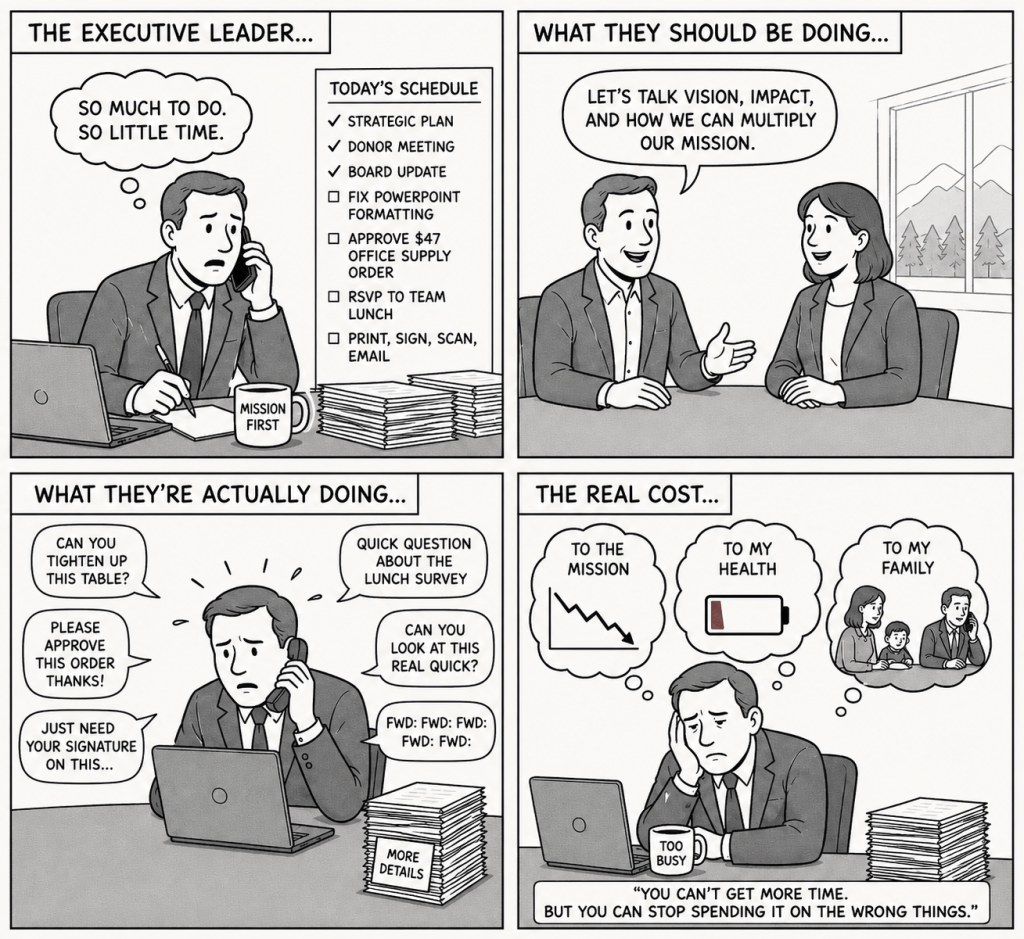
Some executives are uncomfortable with questions about how they allocate their most valuable resource – their time. They experience it as intrusive or mistrustful. But transparency about time is simply one dimension of the accountability that comes with executive authority and the positive trade-off of having more control over your time.
Your time is expensive. Own that.
You should treat your time as genuinely expensive. Dan Martell, in his widely-read book Buy Back Your Time, makes a point that every executive leader should internalize: you need to assign an honest dollar value to your time and then audit whether you are actually spending it accordingly. When an executive leader is fixing formatting on a document, approving minor purchases, or sitting in meetings that could be run by someone else, the organization is not getting what it paid for.
Your time is expensive to your health. Chronic overextension can be a slow drain on the physical energy and cognitive capacity you need for the work only you can do. And your time is expensive to your family. The hours you spend managing what could be delegated are hours you are not spending on the relationships and renewal that make long-term leadership sustainable.
The goal of a time audit is not to perform busyness accountability for your board. It is to ask honestly: Am I spending the most expensive resource I have, where it produces the highest return for the mission, for the people I lead, and for my own long-term capacity?
A Word for Boards
None of this is threatening to a healthy governance relationship. A board that genuinely wants its leaders to lead well, lead long, and lead sustainably should want to have this conversation.
FOR THE LEADER: Monthly Time Reflection Questions
- When I look at how I spent my time this month, does the allocation reflect my stated priorities?
- Which activities had the highest return for the mission? Did I protect enough time for them?
- What consumed significant time that I could or should have delegated, and what did that cost the organization, my health, or my family?
- Were there people, relationships, or initiatives that deserved my attention this month that I didn’t get to? What got in the way?
- If I showed next month’s calendar to my board chair today, could I defend every major block with confidence?
FOR THE BOARD: Reasonable/Caring Questions for a Policy Governance Board
- How did your time allocation this month align with the organization’s current strategic priorities?
- Which areas produced the most meaningful progress toward our ends policies or key results?
- Were there responsibilities that consumed disproportionate time relative to their strategic value, and what would need to change to address that?
- How are you protecting time for strategic leadership as distinct from operational management?
- What are you currently doing that should be delegated, restructured, or eliminated to increase your effectiveness and sustainability?
- How are you managing your own capacity (physically, relationally, cognitively) so you can lead well over the long term?
Two Tools Worth Using Together
We recommend pairing two simple exercises: a Monthly Time Audit and a Task Assessment Conversation Guide.
The Monthly Time Audit encourages you to estimate the percentage of your time spent across six or seven categories and rate each for strategic value.
The Task Assessment Conversation Guide goes one level deeper. Rather than looking at categories of time, it looks at individual tasks. Here is how to use it:
- List your 8–12 recurring responsibilities or projects — everything that regularly shows up in your week. For each one, assign two scores.
- First, a calling alignment score: does this task fit your role, your strengths, and the mission you were hired to advance? Score +1 if yes, –1 if no.
- Second, an energy impact score: does this task energize you or drain you? Score +1 if it gives you life, –1 if it depletes you. Add the two scores together.
The results are honest and often clarifying. A +2 is a sweet spot. A score of 0 or +1 is neutral territory, so it’s worth examining whether adjustments could improve the fit. A –1 or –2 is a warning zone. That task is misaligned, draining, or both. It is a candidate for delegation, redesign, or elimination.
Some essential leadership responsibilities are not glamorous. But there is a meaningful difference between hard and misaligned. When a leader is consistently spending significant time in the warning zone, the organization pays for it, and so does the leader.

