
What leaders often underestimate, or simply don’t see until a crisis emerges, is how quickly relational complexity grows as the organization grows. Systems and skills often don’t keep pace at the same rate as change.
This almost always happens gradually, then suddenly. Schools that began with a few hundred students a decade ago now have over a thousand. Business start-ups that began with two founders now manage whole departments of employees. We often find that leaders eventually land in a place where better systems and leadership rhythms are required to ensure long-term organizational health and sustainability.
Organizations don’t rise to the level of their goals, key objectives or KPIs when they scale in size and complexity. We believe organizations eventually sink or stagnate relative to the quality and capacity of their systems.
When a company is small, culture can feel relatively easy to maintain. Communication is informal. Trust is mostly built through proximity and knowing everyone you work with. Leaders can see almost everything. Problems are noticed quickly. Alignment happens through regular contact, and people can often compensate for weak systems through personality, effort, and responsiveness.
But as an organization grows, all of that changes. A school, for example, might double in enrolment over 10 years but retain almost all of the original board governance structures, policies, procedures and cultural assumptions from 20-years ago when was a grassroots parent-run school. A start-up that grows by a multiple of 10 might still run largely on the energy and efforts of its founders long past the point where that is sustainable or healthy.
More people means more communication paths. More handoffs. More chances for misunderstanding. More pressure on managers to know what is happening. More distance between leadership intent and employee experience. More opportunities for assumptions to form, tensions to linger, and cultural or mission drift to set in. What used to be held together relationally now has to be supported intentionally.
FIND OUT MORE: How teams in large organizations can efficiently evaluate their staff without resource-intensive performance reviews
That is why organizational health becomes more important as you scale. To put it another way, what got you here probably won’t get you to where you want to go – that includes your people, your skills, your systems and your cultural rhythms. Mature and courageous leaders will also acknowledge that as you change, an added challenge is that many of the people you work with will grieve the loss for what you once were.
The hidden math of growth. Relational complexity grows exponentially.
In a company of 5 people, there are 10 direct relational connections. In a company of 40 people, there are 780. It isn’t sustainable for a leader or leadership team to manage that. The culture you create intentionally or unintentionally is more important than ever.
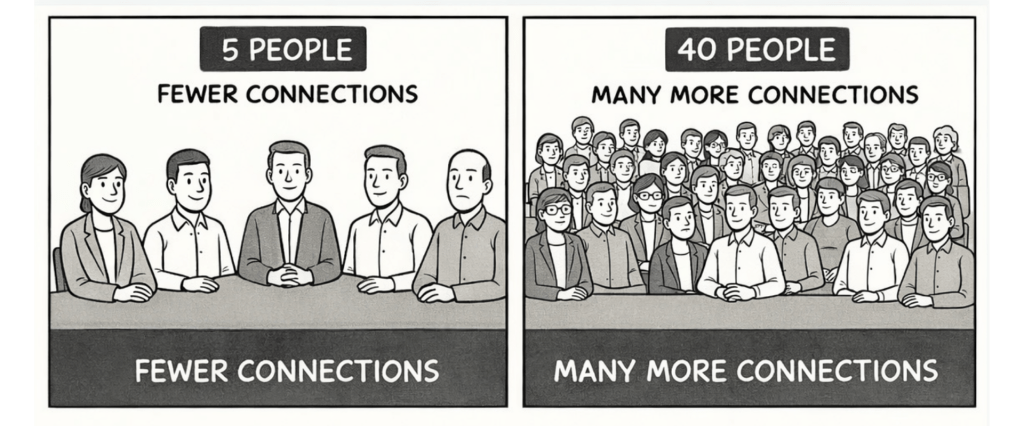
That jump surprises people, but it makes sense. As each new person joins an organization, they do not simply add one more relationship. They add a potential relationship with everyone else. Relational complexity grows exponentially faster than most leaders intuitively feel it growing. So when some people say, “It felt easier when we were smaller,” they are usually right. When a leader feels burned out or strained, it is likely because of relational complexity related a some number of people being people.
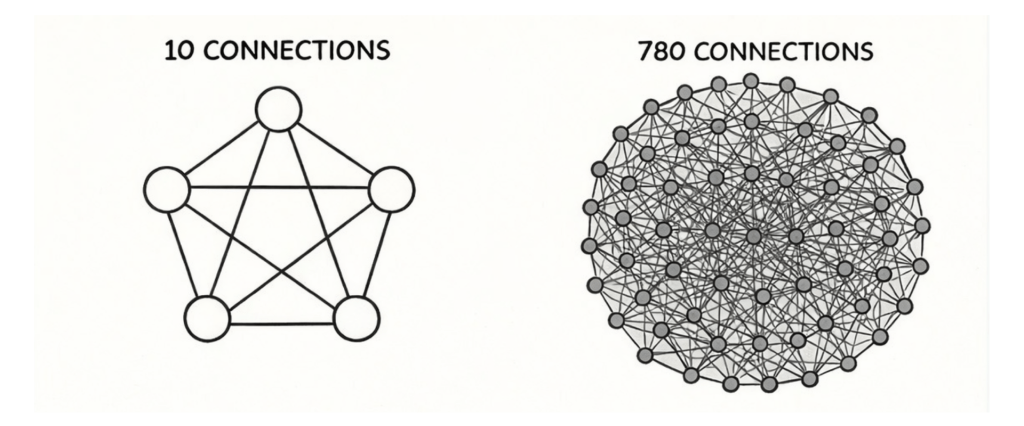
In a smaller organization, success can be fueled almost 100% on instinct, proximity, and energy. In a growing organization, it cannot. At scale, culture must be cultivated. It must be named, reinforced, modeled, measured, and protected. It needs a language, an ecosystem and habits that say without words what Seth Godin describes as “people like us do things like this.”
Culture is not soft or passive. It is structural and intentional. It requires reminders and highly skilled communication skills.
Culture determines whether people merely survive at work or truly thrive and perform together at a high level. A healthy culture helps people think clearly, collaborate honestly, stay motivated, and sustain their energy over time. It allows people to do their work without constantly burning emotional energy trying to interpret mixed signals, navigate unresolved tension, or compensate for unclear expectations.
“Organizational health is the single greatest opportunity for improvement and competitive advantage in business today. It is more important than strategy, finance, or technology.” – Patrick Lencioni
In unhealthy cultures, people may still produce results for a season, but often at unnecessary cost. Anxiety rises. Leaders micro-manage and burn out. Good people get tired. Hard conversations get delayed. Trust becomes fragile. Communication becomes cautious, political, or unclear. And over time, organizational drag sets in.
This is why organizational health should never be treated as a side issue. It is not separate from performance. It shapes performance.
Healthy organizations create leadership freedom. One of the clearest signs of organizational health is that leaders are increasingly free to lead rather than constantly rescue, chase, absorb, or re-do.
When culture is healthy, leaders do not need to micromanage because expectations are clear. They do not need to over-function because ownership is shared. They do not need to constantly play peacekeeper because feedback and conflict are normalized. Ruinous empathy, obnoxious aggression, and manipulative inauthenticity are named and side-stepped. Boundaries are clear and respected.
It allows leaders to trust that others are performing at a high level without slipping into control, enablement, or fatigue. It creates room for better thinking. Better decisions. Better energy. Better execution. Better creativity.
High truth and high care culture requires courageous cultivation. Leaders are “chief reminding officers.”
At their best, healthy organizations operate with both high truth and high care. They tell the truth clearly without being toxic jerks. They attack problems, not people, with a solution-focused hope, humility and grace. They do not confuse niceness with health. They strive to grow and learn to do this in ways that preserve dignity, build trust, and strengthen the team – mission first, people always.
Strong cultures learn how to hold candor and care together. They create the kind of environment where people can speak honestly, receive feedback without unnecessary defensiveness, and work through tension without turning disagreement into a personal threat or power struggle.
The challenge of scaling well.
The central challenge for a growing organization is not simply whether it has a good strategy. It is whether its leadership capacity, cultural clarity, and management systems are growing fast enough to support its next stage of complexity.
That means leaders must become more intentional about things that once happened naturally.
- clarifying purpose,
- defining values,
- strengthening accountability,
- teaching and normalizing healthy conflict,
- improving communication rhythms and language,
- and making sure culture is reinforced not just in words, but in systems.
As organizations scale, relational complexity explodes. That is unavoidable. What is avoidable is pretending that success and growth alone will somehow produce health and sustainability in the long term. Growth amplifies what is already there. If clarity is weak, growth exposes it. If leadership skills are underdeveloped, growth reveals it. If accountability is fuzzy, growth makes it costly.
Organizational health matters more as you scale because complexity always grows faster than we expect.
 Traverse